
The Role of Metabolism in Achieving a Healthy Body
Metabolism is not about "fast" or "slow". It is the engine of life, and we can take care of it through everyday habits.

Metabolism is not about being “fast” or “slow”. It is the engine of life that we can look after through our daily habits.
“My metabolism is slow, that is why it is hard for me to lose weight.” This sentence is heard very often. Many people feel that metabolism is fate that cannot be changed.
In fact, scientific research over the last few decades shows a far more interesting picture.
Metabolism is indeed influenced by inherited factors. However, the size of that influence is often exaggerated. It is precisely the factors we can control, such as muscle mass, eating patterns, daily activity, and sleep, that play a big role.
This article discusses what metabolism is, the myths that need to be set straight, and real steps to keep it healthy, based on findings from internationally reputable scientific journals.
What Exactly Is Metabolism?
Metabolism is all the chemical processes in the body that turn food into energy and the materials for building cells. This process runs non-stop, even while we sleep. The heart beats, the brain thinks, and cells repair themselves, all of which need energy from metabolism.
Our daily energy expenditure is made up of three main components:
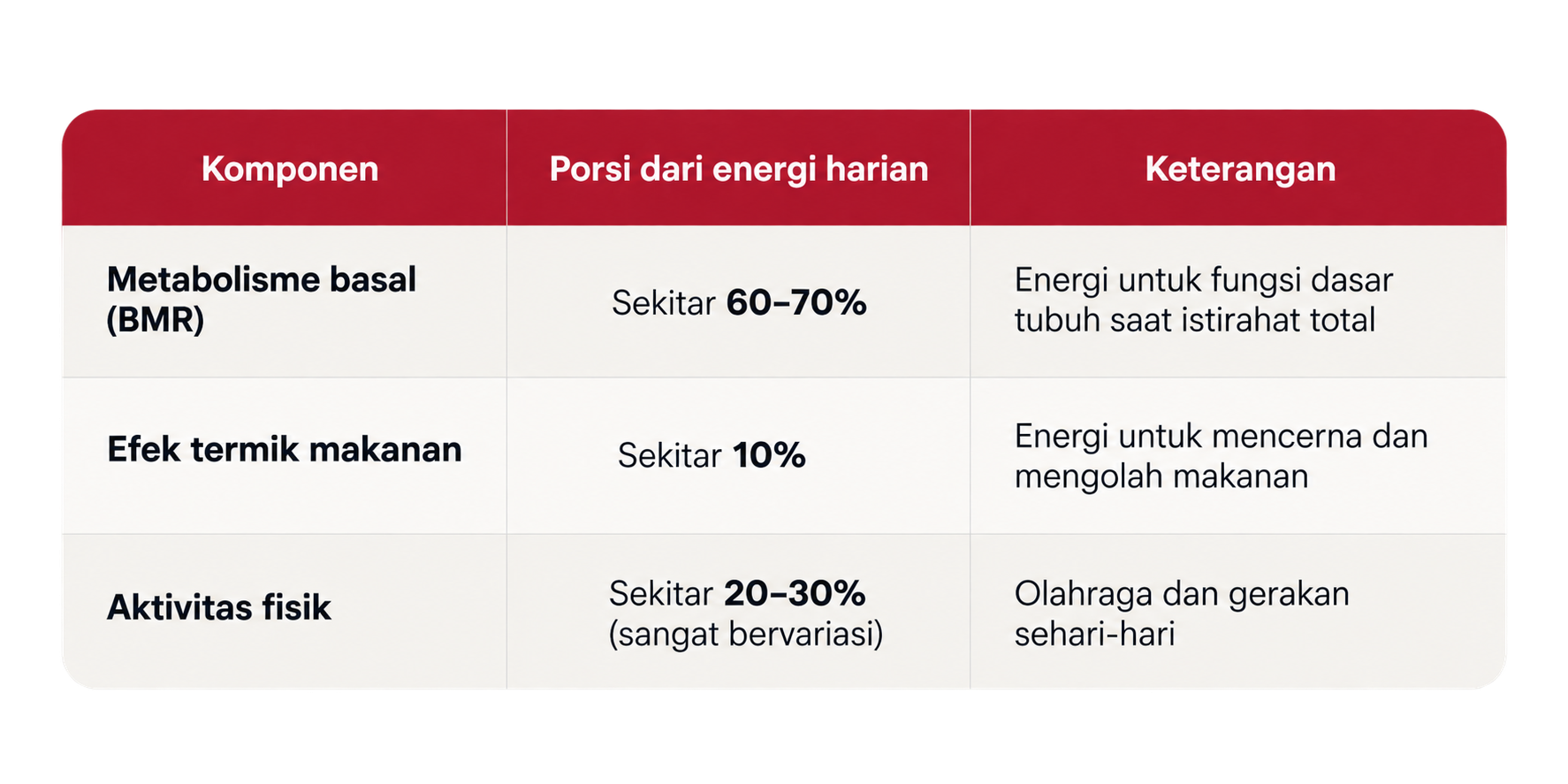
What determines how large or small the basal metabolism is? A study in the American Journal of Clinical Nutrition of 150 adults found that fat-free mass, especially muscle and organs, explained about 63% of the differences in BMR between individuals. Fat mass explained only about 6% and age about 2%. This means body composition matters far more than simply what is “inherited”.
The activity component also holds a surprise. Besides exercise, there is something called NEAT (non-exercise activity thermogenesis): energy from walking, standing, climbing stairs, or cleaning the house.
Research in the journal Science showed that when people were given an excess of 1,000 calories per day, some people naturally increased their NEAT by almost 700 calories per day. Those with the highest NEAT were the ones who gained the least fat.
Myth: “After Age 30, Metabolism Drops Straight Away”
Many people blame age when their weight goes up in their 30s or 40s. A large study in the journal Science tested this assumption. Researchers analyzed energy expenditure data of more than 6,400 people from 29 countries, from babies eight days old to elderly people aged 95.
The result was surprising. After accounting for body size, adult metabolism turned out to be relatively stable from age 20 to about 60. A real decline only happens after age 60, and even then slowly, at about 0.7% per year.
So weight gain during the productive years is more often caused by lifestyle changes. We sit more, get busier, sleep less, and slowly lose muscle mass. The good news is that all of these factors can be improved.
Muscle: The Metabolic Engine That Is Often Forgotten
Muscle is not just for bodybuilders. Skeletal muscle is the largest metabolic organ in the body. Muscle takes up most of the blood sugar after a meal, stores protein reserves, and helps the body get through illness. People with good muscle mass tend to have better blood sugar control and a lower risk of type 2 diabetes.
Unfortunately, without training, muscle mass slowly decreases with age. For this reason, two important things for keeping muscle are resistance training and enough protein intake.
A meta-analysis in the British Journal of Sports Medicine that summarized 49 clinical trials showed that protein helps increase muscle mass in people who regularly do resistance training. The benefit tends not to increase further above about 1.6 grams of protein per kilogram of body weight per day. This figure is a reference for people who train. Each person’s needs can differ, especially for people with kidney disease, so it should be consulted with a doctor.
Protein has another advantage too. The body burns more energy to digest protein, about 20-30% of its calories. Compare that with carbohydrates (5-10%) and fat (0-3%). Protein also keeps you full longer.
Extreme Diets: Down Fast, Back Fast
Many people are tempted by very strict diets to lose weight drastically in a short time. The problem is that our bodies have a defense mechanism. When energy intake drops sharply, the body “saves” energy by lowering metabolism more than expected. This phenomenon is called metabolic adaptation or adaptive thermogenesis.
The most famous example comes from the participants of the weight loss TV show The Biggest Loser. A study in the journal Obesity followed 14 participants for six years after the competition. On average they lost about 58 kg during the show. Six years later, most of the weight came back, but their basal metabolism stayed about 500 calories per day lower than predicted.
The lesson is clear: weight loss that is too fast and extreme can “fight back”. A gradual approach, with enough protein intake and resistance training to keep muscle, is friendlier to metabolism in the long term.
Not Only How Much, but What You Eat
For a long time, the focus of dieting has often been only on the number of calories. In fact, the type of food also affects how the body regulates energy.
A clinical trial in the journal Cell Metabolism involved 20 adults who lived in a research facility for four weeks. For two weeks, they were given ultra-processed food, such as sweet cereal, packaged bread, and ready-to-eat meals. For the other two weeks, they were given fresh or minimally processed food. Both menus were set up with equal calories, sugar, fat, salt, and fiber, and the participants could eat as much as they wanted.
As a result, when eating the ultra-processed menu, participants consumed about 500 more calories per day and gained an average of 0.9 kg in two weeks. When eating the minimally processed menu, their weight actually went down.
Examples of ultra-processed food include instant noodles, sausages and nuggets, sweet packaged drinks, and packaged snacks. You do not have to avoid them completely, but make fresh food the main menu.
Sleep: A Pillar of Metabolism That Is Often Sacrificed
Staying up late for work or looking at a phone until late at night has become a habit for many people. It turns out that lack of sleep has a direct effect on metabolism.
Classic research in the journal The Lancet showed that healthy young men who slept only four hours a night for six nights had a drop in glucose tolerance. Their metabolic condition resembled that of people in the early stages of diabetes. After sleep was restored, this condition improved.
Lack of sleep also ruins diet results. A study in the Annals of Internal Medicine compared people on a diet with sleep times of 5.5 hours and 8.5 hours. With the same calorie reduction, the sleep-deprived group lost 55% less fat and lost 60% more muscle mass. They also felt hungrier.
This means sleeping 7-9 hours a night is not a luxury, but part of a healthy living program.
Practical Steps to Look After Your Metabolism
Based on the scientific evidence above, here are simple steps you can start today:
- Do resistance training 2-3 times a week. It can be with dumbbells, resistance bands, or your own body weight such as squats and push-ups.
- Get enough protein at every meal. Choose varied sources: fish, eggs, chicken, tempeh, tofu, and legumes.
- Move more outside of exercise. Take the stairs, park farther away, stand while on the phone, and break up long sitting with a walk every 30-60 minutes.
- Put fresh and minimally processed food first. Fill half of your plate with vegetables and fruit, following the “Isi Piringku” guidelines.
- Avoid extreme diets. Aim for gradual weight loss, about 0.5-1 kg per week.
- Get enough sleep, 7-9 hours. Limit screen time one hour before bed and keep a regular sleep schedule.
- Have regular health check-ups. Conditions such as hypothyroidism or diabetes can affect metabolism and need to be treated by a doctor.
Metabolism is not an inherited verdict that cannot be changed. Research shows that age is not the main reason metabolism slows down before 60. The factors with the most influence are things we can control: keeping muscle, staying active, choosing quality food, avoiding extreme diets, and getting enough sleep.
A healthy body is not the result of instant methods, but of small, consistent habits. If you have a certain medical condition or want a nutrition program that fits your personal needs, consult a clinical nutrition specialist doctor.
Reference:
- Fothergill E, Guo J, Howard L, et al. Persistent metabolic adaptation 6 years after “The Biggest Loser” competition. Obesity. 2016;24(8):1612–1619. doi:10.1002/oby.21538
- Hall KD, Ayuketah A, Brychta R, et al. Ultra-processed diets cause excess calorie intake and weight gain: an inpatient randomized controlled trial of ad libitum food intake. Cell Metabolism. 2019;30(1):67–77. doi:10.1016/j.cmet.2019.05.008
- Johnstone AM, Murison SD, Duncan JS, et al. Factors influencing variation in basal metabolic rate include fat-free mass, fat mass, age, and circulating thyroxine but not sex, circulating leptin, or triiodothyronine. American Journal of Clinical Nutrition. 2005;82(5):941–948. doi:10.1093/ajcn/82.5.941
- Levine JA, Eberhardt NL, Jensen MD. Role of nonexercise activity thermogenesis in resistance to fat gain in humans. Science. 1999;283(5399):212–214. doi:10.1126/science.283.5399.212
- Morton RW, Murphy KT, McKellar SR, et al. A systematic review, meta-analysis and meta-regression of the effect of protein supplementation on resistance training-induced gains in muscle mass and strength in healthy adults. British Journal of Sports Medicine. 2018;52(6):376–384. doi:10.1136/bjsports-2017-097608
- Nedeltcheva AV, Kilkus JM, Imperial J, et al. Insufficient sleep undermines dietary efforts to reduce adiposity. Annals of Internal Medicine. 2010;153(7):435–441. doi:10.7326/0003-4819-153-7-201010050-00006
- Pontzer H, Yamada Y, Sagayama H, et al. Daily energy expenditure through the human life course. Science. 2021;373(6556):808–812. doi:10.1126/science.abe5017
- Rosenbaum M, Leibel RL. Adaptive thermogenesis in humans. International Journal of Obesity. 2010;34(Suppl 1):S47–S55. doi:10.1038/ijo.2010.184
- Spiegel K, Leproult R, Van Cauter E. Impact of sleep debt on metabolic and endocrine function. The Lancet. 1999;354(9188):1435–1439. doi:10.1016/S0140-6736(99)01376-8
- Westerterp KR. Diet induced thermogenesis. Nutrition & Metabolism. 2004;1(1):5. doi:10.1186/1743-7075-1-5
- Wolfe RR. The underappreciated role of muscle in health and disease. American Journal of Clinical Nutrition. 2006;84(3):475–482. doi:10.1093/ajcn/84.3.475
Discussion
Comments & Questions
Share your comments or questions about this article.